


Welcome to Racing: Preparation Wins Before the Gate Drops
Racing is exciting. It is loud, fast, competitive, and sometimes chaotic. But after years of racing ATVs, go-karts, and cars, one thing becomes very clear:
The race is often won before you ever leave the driveway.
If you are getting into mini ATV racing, there are a few things you need to know right away. Speed matters. Riding ability matters. But preparation, setup notes, and consistency are what separate the racers who keep improving from the racers who keep guessing.
At DRR USA, we learned these lessons the hard way over many years at the track.
Keep a Racing Notebook
Every racer should keep a notebook or log. This is where you write down what worked, what did not work, and what changed from one race to the next.
Your notebook should include:
Gear ratio
Air temperature
Track temperature
Tire pressure
Tire circumference
Clutch lockup RPM
Top RPM
Top speed
How long it takes to get to top speed
Jetting or tuning changes
Track condition
Rider comments
Final results
This information becomes your personal racing database. When you go back to the same track, you are not starting from zero. You already know what gear ratio worked, what tire pressure worked, what RPM the clutch liked, and what the ATV did in those conditions.
That is how you get better.
Use a Tach-Temp Gauge
A tach-temp gauge is one of the most important tools you can bring to the track.
You need to know where your engine is running. You need to know your top RPM. You need to know your clutch lockup RPM. You need to know when the engine or clutch starts falling off.
If your clutch used to lock up at a higher RPM and now it is locking up lower, that is a sign something changed. The motor may not be pulling as hard. The clutch may need attention. The tune may be off. The setup may not match the track.
Those small differences can decide whether you win or lose.
That is true in mini ATV racing. It is true in go-karts. It is true in full-size race cars.
Gear for the Track, Not for Bragging Rights
One of the biggest mistakes new racers make is chasing top speed.
Top speed sounds great, but it only matters if the track gives you enough room to use it.
If your ATV is geared to fly down a half-mile straightaway, but the track only has short straights that are an eighth-mile or a tenth-mile long, you may never reach that speed. That means you are giving up acceleration for speed you will never use.
The goal is to gear the ATV for the track you are actually racing on.
Our rule of thumb is this:
On the longest straightaway, you want to reach your top speed by about halfway down the straight. Then you maintain it for the second half.
That means the ATV gets off the corner hard, pulls quickly, and reaches its usable speed early. Racing is not just about the highest number on the speedometer. Racing is about getting to the next corner before the other rider.
Always Use the Same Tire Pressure Gauge
Here is another important tip learned over years of racing:
Always use the same tire pressure gauge.
Do not keep switching gauges. Do not borrow one from someone else and assume it reads the same. Even if another gauge looks better, newer, or more expensive, it may not read exactly like yours.
The number is not the only thing that matters. Consistency matters.
If your gauge says 6 pounds, and your ATV works great at that setting, then that is your reference. If you change gauges, you may think you are running the same pressure, but the tire may actually be different.
Use the same gauge every time. Keep it safe. Keep it with your race gear. No matter how long you own it, do not replace it unless you absolutely have to.
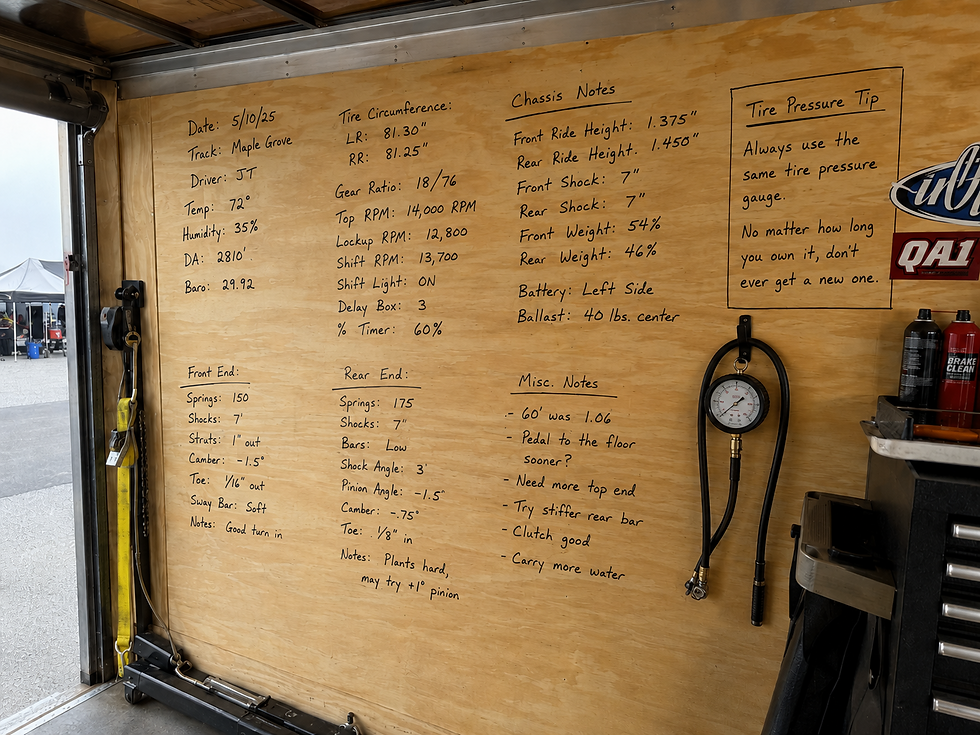
When the Notebook Disappeared, We Used the Trailer Wall
Over the years, we learned how valuable setup notes were.
We wrote down gear ratios, clutch lockups, RPM, tire circumference, temperature, tire pressure, and track conditions for every event.
The problem was that notebooks disappeared.
Sometimes they got misplaced. Sometimes someone wanted to see our gear ratios or clutch numbers. Sometimes the notebook simply vanished.
So we changed the system.
Our race trailer had plywood on the inside walls, so we started writing our notes directly on the trailer wall with a marker.
The date. The track. The temperature. The tire circumference. The gear ratio. The top RPM. The lockup RPM. Everything went on the wall.
You cannot forget the wall at home. You cannot lose it in the pits. It is always there when you open the trailer.
That plywood wall became one of the most valuable tools we had.
The Most Important Step: Use a Checklist Before You Leave
The most important preparation happens before you ever pull out of the driveway.
You need a checklist.
Not a mental checklist. Not “I think we have everything.” A real checklist.
We used the same checklist for cars and go-karts for years because it kept us from forgetting important items. Mini ATV racing should be treated the same way.
Before you leave for the track, check off the basics:
Log book or race paperwork
License or membership documents
Transponder and charger
Radios
Helmet
Gloves
Racing shoes or boots
Riding gear
Laptop or tuning tools
Tach-temp gauge
Tire pressure gauge
Tire temperature gauge
Air compressor
Tire inflator
Fuel
Oil
Torque wrench
Spare wheels
Spare tires
Jack
Jack stands
Battery jumper
Battery charger
Extension cords
Camera
Camera charger
SD cards
Spare belts
Basic tools
Spare hardware
Brake parts
Cleaning supplies
Wipe-down towels
Lights for the pit area
Allergy medicine or personal items
Spill pan
A simple checklist can save your whole weekend.
Forgetting a helmet, charger, transponder, tire gauge, belt, or basic tool can ruin a race day before it even starts.
Preparation is not glamorous, but it wins races.
Do Not Wait Until Race Morning
Race morning is not the time to get organized.
Race morning is for unloading, checking the track, warming up the machine, checking tire pressure, watching conditions, and getting the rider mentally ready.
Your gear should already be packed. Your checklist should already be checked. Your tire gauge should already be in the trailer. Your notes should already be ready.
When you show up prepared, you are calm. When you are calm, you make better decisions. When you make better decisions, the rider has a better chance to win.
Racing Is Testing, Recording, and Repeating
Mini ATV racing is not guessing.
It is testing, recording, adjusting, and repeating what works.
You test a gear ratio. You write it down. You check the RPM. You write it down. You adjust tire pressure. You write it down. You learn what the ATV wants at that track, on that day, in those conditions.
That is how a racer grows.
The rider still has to ride. The machine still has to perform. But the team that keeps records, uses a checklist, and prepares correctly will always have an advantage.
Final Lesson
Welcome to racing.
It is fun. It is competitive. It is emotional. And it teaches you fast that little details matter.
Keep a notebook. Use a tach-temp gauge. Always use the same tire pressure gauge. Gear for the track, not for bragging rights. Write your setup notes where you cannot lose them. And before you leave for the track, use the same checklist every time.
Because in racing, preparation is not just part of the process.
Preparation is the race.


Comments